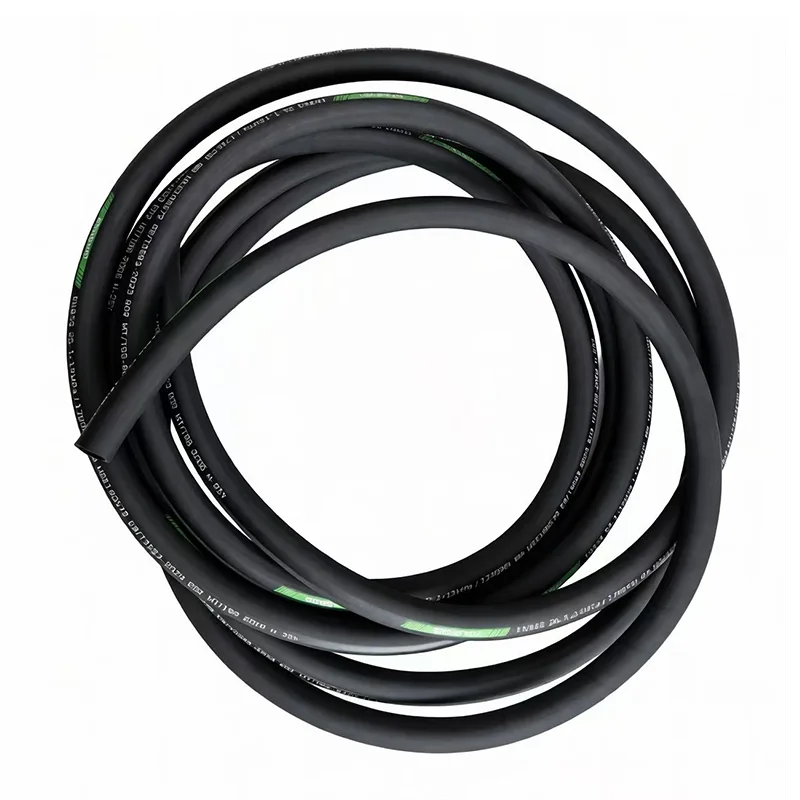
Check the printing marks on the tube body: The outer layer of hydraulic rubber hoses is usually printed with inner diameter related parameters, and there are two common ways of identification:
Represented by "- number": The number represents a multiple of the inner diameter of 1/16 inch, for example -6 corresponds to an inner diameter of 3/8 inch, approximately 9.5mm.
Directly label the nominal inner diameter (unit: mm): for example, "16" in the label represents a nominal inner diameter of 16mm for the hose.
Some imported hoses will be directly labeled with "I.D." (Inner Diameter) followed by the inner diameter value, which can be read directly.
2. Actual measurement through tools
Plug gauge measurement: For hoses with a nominal inner diameter less than 150mm, a plug gauge with a diameter increment of 0.25mm can be used to slowly insert into the pipe without applying pressure for measurement.
Special measuring tools for measurement: Steel wire reinforced hydraulic hoses with high precision requirements can be measured using expansion ball or telescopic inner diameter gauges.
Vernier caliper measurement: For hoses within 100mm, use the measuring claws of the vernier caliper to measure at two perpendicular positions, take the average value, and be careful to avoid deformation of the hose that may affect the results.
3. Auxiliary reference method
Calculated according to system parameters: Based on the flow rate and allowable flow velocity of the hydraulic system (usually ≤ 6m/s), the required inner diameter is calculated using the formula for flow cross-sectional area, and then matched with the corresponding standard specification hose.
Refer to the national standard specification table: You can refer to the hydraulic hose nominal inner diameter series in GB/T 2351-2021 standard to confirm the corresponding standard inner diameter values.
We use cookies to offer you a better browsing experience, analyze site traffic and personalize content. By using this site, you agree to our use of cookies. Privacy Policy